Two news stories about illegal gambling halls emerged this week. On November 13, it became known that a court in Kharkiv fined three organizers of a "sports poker club" UAH 680,000 each. Then, on November 17, it was reported that the Bureau of Economic Security (BEB) referred to court the case of another member of a group that operated halls in Mostyska and Shehyni in the Lviv region, near the border with Poland, from February 2023 to November 2024. Both cases date back to 2024, and the state is still untangling these networks.
Crackdowns on Underground Networks and Evolving Tactics
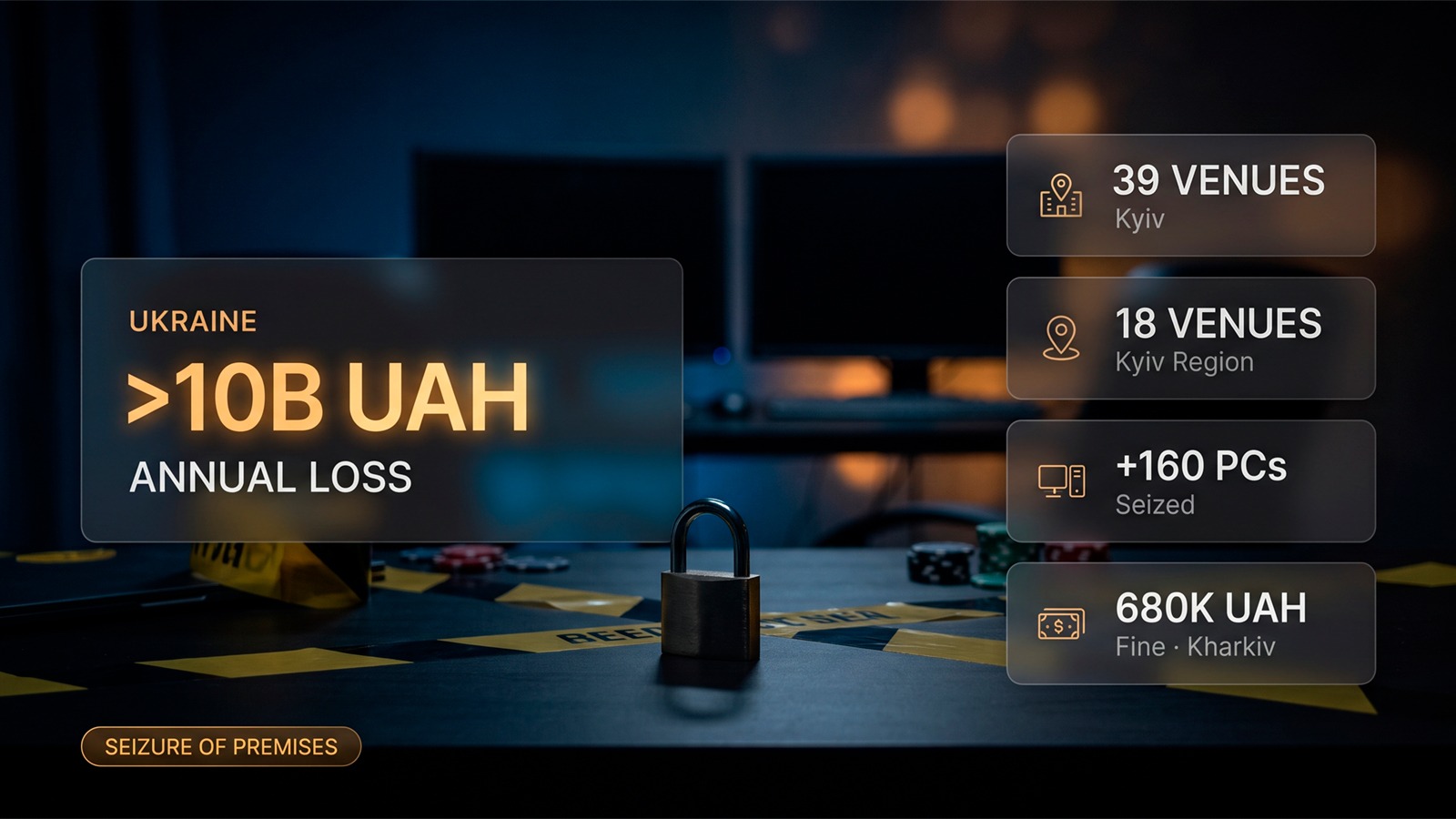
Over this period, the BEB has dealt major blows to the underground sector. In December 2025, 18 illegal venues across five districts in the Kyiv region were shut down and more than 160 computers were seized. In August 2026, a case involving a network of 39 halls in Kyiv went to court. Networks in the capital and surrounding region have been halted, and their organizers are being held accountable.
However, the underground sector adapts. Such halls operate behind closed doors: admitting only regular clients and by prior arrangement, with camera-monitored entrances and cash payments. Some even operated during curfew. In Mostyska and Shehyni, standard computers running online slot simulators were used instead of slot machines. Finding such a venue is much harder than locating a hall with a storefront sign.
Budget Impact and Player Protections
How much does this cost the state? According to BEB estimates, the illegal gambling business costs the budget more than UAH 10 billion every year. The Bureau does not specify the share generated by brick-and-mortar halls. Yet the state receives nothing from the money a player leaves in an illegal hall, whereas every hryvnia from the legal gambling business goes into the state budget and strengthens it. Moreover, in the underground sector, players are not protected by spending limits or the self-exclusion register.