With casino empire gone, Trump family now betting on prediction markets
Monday 23 de March 2026 / 12:00
⏱ 9 min read
(Atlantic City).- Having left behind the casino business, the Trump family has found a new source of income in prediction markets. Trump Media and Technology Group has announced plans for its own prediction cryptocurrency-based platform called Truth Predict.
Trump Media and Technology Group, the largest source of the president’s wealth since it went public in 2024, has announced plans for its own prediction cryptocurrency-based platform called Truth Predict. And the president’s oldest son, Donald Trump Jr., is an adviser to the two largest prediction market companies, Kalshi and Polymarket, and is an investor in the latter.
Unlike Trump’s first attempts to offer sports betting in New Jersey, when he needed help from hostile lawmakers and regulators, his own presidential administration and handpicked appointees are now writing the rules for the emerging prediction market industry.
The Commodity Futures Trading Commission and its Trump-appointed commissioner are trying to shield these nascent markets from state laws that regulate or ban sports-betting — because they’re legally constructed as event contracts, which are regulated differently than gambling.
Because the CFTC’s actions could help the president’s company, the potential conflicts of interest have already drawn scrutiny from ethics watchdogs.
This dynamic also puts the Trump administration and his family at odds with the casino industry — one that helped make him a household name and produced a handful of moguls who have contributed more than $200 million to support his political ambitions over the past decade, according to campaign finance reports. Casino operators have watched with growing alarm as sports-style wagering has exploded on prediction markets, cutting into their business in ways they maintain are illegal.
“He advocated for sports gambling at a time when there was no sports betting,” said former New Jersey Gov. Chris Christie, who is now a lobbyist for the gaming and casino industry. “What he’s doing (now) is messing up something that has operated extraordinarily well.”
A person close to the gaming industry who asked not to be named because of the Trump administration’s power over their business acknowledged the Trump family’s involvement in prediction markets is a “huge factor in the politics of this.” Casino operators see little opportunity to sway the administration, and Republicans in Washington are hesitant to weigh in on a fight that could hurt the Trump family business. "It’s the elephant in the room,” the person said.
In a statement to CNN responding to these concerns, White House spokesperson Davis Ingle said, “The only special interest guiding the Trump Administration’s decision-making is the best interest of the American people.”
Andrew Surabian, a spokesperson for Trump Jr., told CNN that the president’s son does not trade on prediction markets, and his role with Kalshi and Polymarket is limited to advice about marketing strategies. Surabian added that Trump Jr. has not interacted with the federal government on behalf of either company.
CNN has a partnership with Kalshi and uses its data to cover major events. Editorial employees are prohibited from participating in prediction markets.
‘We’re in the wild west’
Prediction markets let users bet on everything from sports and elections to business, entertainment, or even the daily high temperature in various cities or the number of measles cases per year.
Markets about the ongoing US-Israeli war in Iran have grown in popularity, stirring controversy over potential insider trading by government officials, and over so-called “death markets” that pay out upon someone’s killing, like Iran’s ayatollah.
There are key differences in how the biggest players in the industry operate. Kalshi is federally regulated in the US by the CFTC, and it bans insider trading. Polymarket’s US site is also CFTC-approved but isn’t fully operational yet, so its most viral markets are offshore and unregulated – and its CEO has touted the role of insiders.
Trading on prediction markets spiked around the 2024 election, and it has significantly increased in the past several months. Users around the world now regularly spend more than $5 billion total each week on prediction platforms, according to Artemis Analytics.
It is the proliferation of sports-related trades on these sites, though, that has lately attracted the ire of the American Gaming Association, the industry group that represents casinos. The Super Bowl in February served as a flashpoint in their fight: Kalshi reported more than $1 billion in trading activity that day while bets on the game placed in-person at Nevada casinos reached a 10-year-low.
Because activity that mimics sports betting regularly dominates prediction markets, casinos argue these companies essentially operate unlicensed online sportsbooks – where users don’t pay state gambling taxes on winnings and can place bets even where sports betting is banned.
States like Nevada and New Jersey, where gambling is allowed but strictly regulated, have responded with lawsuits, and Kalshi has sued several states to try to block their regulations.
Kalshi denies wrongdoing and says prediction markets can only be regulated by the federal government.
The legal battle has set off a flurry of lobbying activity in Washington that “didn’t even exist a few months ago,” said Dustin Gouker, an independent journalist who covers prediction markets. Companies operating prediction markets spent $14 million on lobbying in 2025, according to federal filings, though some companies, like the crypto company Coinbase, also have other interests before the federal government.
“If this goes south, and prediction markets get regulated in a way that they don’t want, that would be really bad for their sustainability as an industry,” Gouker said. A crackdown on prediction markets, though, would also be a crackdown on a burgeoning sector of the Trump family’s business interests.
“We’re in the wild west of predictive markets and the fact that the president’s son is so financially tied to them raises questions about the administration’s appetite to closely regulate them,” said Donald Sherman, who runs the left-leaning watchdog group, Citizens for Responsibility and Ethics in Washington.
Trump’s old casino allies alarmed
A casino industry with prominent players once close to the president is now fighting his administration. In addition to the American Gaming Association, an allied group called Gambling Is Not Investing has hired former Trump budget director Mick Mulvaney to lobby against prediction markets.
But Rep. Dina Titus, a Democrat who represents the Las Vegas strip, said casinos have been slow to respond to this threat, and she suggested the industry’s close ties to Trump could be a reason. “They didn’t want to upset the applecart,” Titus told CNN.
Many of the city’s most well-known casino operators have long supported the president.
The late casino magnate Sheldon Adelson and his wife Miriam donated more than $190 million to re-elect Trump in 2020 and 2024 combined.
Phil Ruffin, who operates some of the strip’s most iconic casinos and co-owns the (casino-free) Trump International Hotel Las Vegas, spoke at the 2016 Republican National Convention and has donated about $6 million in support of president over the past decade.
Steve Wynn, who built and operated casinos in Vegas and Atlantic City, served as finance chair for the RNC during Trump’s first term and financially supported him through the 2024 election, and Tilman Fertitta, who is US ambassador to Italy, owns casinos and is a prolific Trump donor.
Cashing in on sports betting
In most states, sports betting is only slightly older than prediction markets.
A landmark US Supreme Court ruling in 2018 struck down a federal ban on sports betting and paved the way for the online gambling boom that has spread throughout the country. Once confined to Nevada, wagering on professional and college athletics is now allowed in 40 states and Washington, DC.
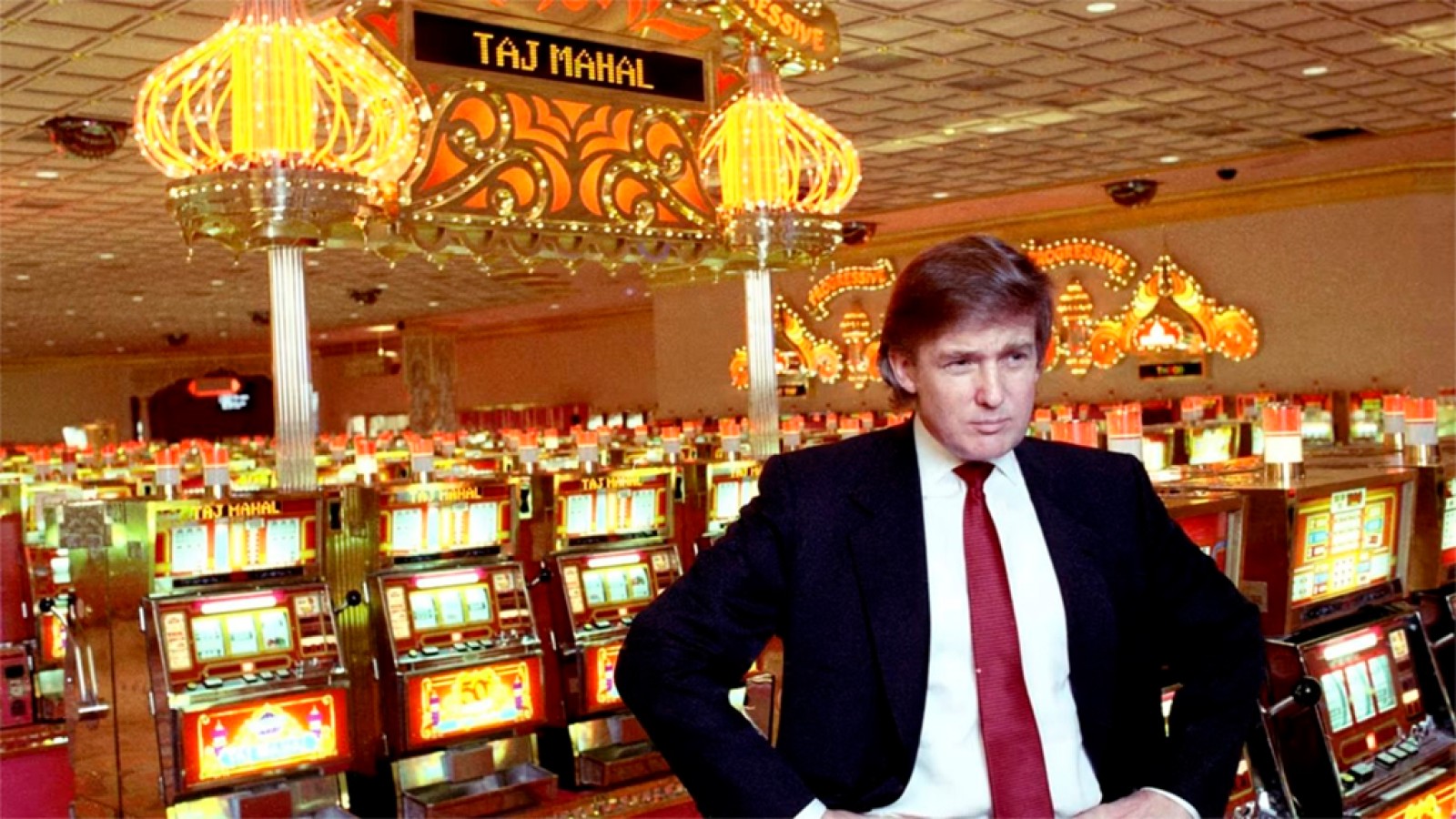
Trump’s casino empire had long crumbled before New Jersey legalized sports betting in the aftermath of the 2018 ruling. But the allure has always intrigued Trump — both as a casino owner and longtime spectator. He asserted in 1996 that he won $20 million betting Evander Hollyfield would best Mike Tyson in the decade’s most notorious heavyweight fight — a dubious claim that Vegas bookmakers dismissed, according to news reports at the time.
As he pushed New Jersey to approve sports betting in the 1990s, he predicted Atlantic City’s casino industry would “cease to exist” without it. He argued it would boost state coffers with tax dollars and squash the state’s notorious illicit gambling problem.
“It’s vital to putting the bookies out of business,” Trump told a local television reporter in 1993, cutting a familiar figure in a custom-branded hat and red tie.
Now, opponents of prediction markets argue Trump’s family is profiting off what is essentially a new form of gambling that limits tax benefits for states and has existed in a legal gray area.
“They’re allowing a group of renegade cowboys to go about the country in an unregulated way, not doing anything to help people with gambling issues, not giving taxes to the states,” Christie told CNN. “The president and his family will have to explain whether there’s personal interest in what his administration has done.”
Feds want industry to ‘flourish’
One year in, the Trump administration has embraced prediction markets by ending investigations and using regulatory agencies to encourage growth.
The Justice Department and the Commodity Futures Trading Commission, which regulates prediction markets, ended existing probes into Polymarket last summer. Last week, CFTC Chairman Michael Selig said he hopes prediction markets will “flourish” under his watch, and said the agency is pursuing “a more free-market approach than the Biden administration.”
To that end, the CFTC recently announced new guidance reminding companies that it’s already illegal to offer markets related to assassination, war, or terrorism and urging companies to avoid markets “readily susceptible to manipulation” by individual actors, like athletes.
Experts said the guidance and a related rulemaking proposal fit with the administration’s pro-industry posture, but they also follow a longstanding practice of leaning into self-regulation. “The CFTC is almost doing PR for the industry,” Gouker said.
CFTC spokesperson Brooke Nethercott said Selig wants to ensure that federal regulations stick, while keeping the “exciting” new industry growing, with “millions of Americans using these products.”
“The CFTC is focused on creating a regulatory environment where this industry can flourish in America – under the agency’s regulatory purview, rather than pushing them to unregulated markets offshore,” Nethercott said.
In response to CNN’s questions about Trump’s family connections to the industry, Nethercott said Selig has never spoken with Trump Jr. about any matters related to prediction markets.
“Any entity seeking CFTC registration and the ability to operate in our markets walks through the front door and engages directly with our seasoned career staff,” Nethercott said, adding that it is “disingenuous and dishonest to suggest” that the agency’s procedures “have somehow been corrupted.”
State AGs take action
With limited action from the federal government, state attorneys general have stepped into the void.
Democratic and Republican state AGs are trying to enforce state gaming laws against major sites like Kalshi. So far, they’ve notched some victories in court, though there are dozens of cases and appeals pending.
“There are only a few things right now that unite attorneys general from both parties, and prediction markets are definitely one of them,” former New Jersey Attorney General Matthew Platkin, a Democrat, said in an interview.
Meanwhile, Selig has argued that the CFTC, not the states, has exclusive authority to regulate these platforms because the event contracts they offer are legally classified as a financial instrument called a derivative swap under federal law — and therefore don’t fit the traditional definition of gambling.
Officials in Nevada, the country’s gaming mecca where the president’s last name is emblazoned on a hotel at the Las Vegas strip’s northern end, are leading the charge with lawsuits against these companies and by ratcheting up their rhetoric against the CFTC chairman.
Members of Congress are responding as well. Lawmakers have proposed at least six bills this year to further regulate prediction markets – including proposals to ban insider trading by US officials, shut down markets involving elections, and beef up CFTC enforcement.
Almost all of these proposals have come from Democrats, but Rep. Blake Moore, a Utah Republican, has co-written a bipartisan bill that seeks to ban prediction market wagers on sports, terrorism, war and assassinations.
“We’ve already determined for decades that these types of things should not be available – we’re just trying to add teeth to what already exists,” Moore told CNN, adding that these markets are “ripe for complete debauchery.”
Moore said he hasn’t faced “any particular pressure from the White House” about his bill. But asked whether a GOP-led Congress has the appetite to impose guardrails on an industry tied to Trump family interests, he paused for several beats.
“Any legislation is challenging,” he said.
Categoría:Casino
Tags: Sin tags
País: United States
Región: North America




Event









SiGMA North America 2026
01 de September 2026
LatAm Regulators Discussed Illegal Gambling and Innovation at SiGMA North America
(Mexico City, SoloAzar Exclusive).- The panel "The Red Pen Forum: Regulators Respond to the Industry," held during SiGMA North America 2026, brought together representatives from Uruguay, Argentina, Puerto Rico, and Honduras to analyze regulatory challenges, digital transformation, illegal gambling, and the need to adapt lotteries for new generations. The conference was moderated by Rodrigo Cigliutti, Executive Director of CIBELAE (Ibero-American Corporation of State Lotteries and Betting), and featured the participation of Marcelo Visconti, National Director of Lotteries and Quinielas of Uruguay; Carlos Moyano, President of IAFAS Entre Ríos, Argentina; Heidi Hernández Olivo, Deputy Secretary of the Puerto Rico Lottery; and Lissa Mencía, General Director of Lottery Operations and Games at Loto Honduras.
Monday 28 Sep 2026 / 12:00
SiGMA North America Addressed Crisis Management in iGaming
(Mexico, SoloAzar Exclusive).- During SiGMA North America 2026, Rosa Ochoa, founder of the Blue Global Gaming platform and strategic advisor for gaming operators; Iliana María Pineda Echeverri, Chief Legal & Compliance Officer at Wplay.co; Iraid Rosales, Country Manager Mexico at Amusnet; and Elizabeth Maya Cano, Executive President of CORNAZAR, analyzed the key factors in managing crisis situations within the iGaming industry, with a special focus on transparency, communication, technology, and preparation.
Friday 25 Sep 2026 / 12:00
Affiliates and Acquisition: Keys to Regulated Markets in North America
(Mexico City, SoloAzar Exclusive).- During SiGMA North America 2026, Cristopher Guzmán Reyes, Head of Affiliates at Logrand Entertainment Group; Guga Júnior, influencer and slots expert at Scalar Partners; Andrés Gómez, Head of Latin America Go-to-Market Strategy at Admattic; Yambot Aguilera, Gaming and Finance Sales Director at Google; and Paula Gabriel Jiménez, Advertising Client Growth Director for Microsoft at Aleph, analyzed the state and provincial affiliate ecosystem in North America, as well as the acquisition challenges in regulated markets.
Thursday 24 Sep 2026 / 12:00
SUSCRIBIRSE
Para suscribirse a nuestro newsletter, complete sus datos
Reciba todo el contenido más reciente en su correo electrónico varias veces al mes.