Gambling regulation in Peru: evolution towards stability and legal certainty
Wednesday 19 de June 2024 / 12:00
⏱ 3 min read
(Lima, Exclusive SoloAzar) - From the repeal of the 20% tax by the Constitutional Court to the implementation of the Reorganisation and Formalisation Law, the regulation of gambling in Peru has undergone multiple changes. In this article, SoloAzar summarises the presentation by Dr. Constante Traverso, lawyer and head of APEJA, during the PGS, who underlines the need for a stable and fair public policy.

Within the framework of the conferences held during the recent Peru Gaming Show in Lima, Peru, Dr. Constante Traverso, lawyer and director of the Peruvian Association of Entertainment and Gaming (APEJA), opened the agenda with a presentation entitled "Public Policy for the Regulation of Gaming in Peru".
Gaming regulation in Peru has been a complex and evolving issue. Dr. Traverso will examine the history of this regulation, highlighting key milestones and proposing the need for a coherent and stable public policy for the future.
Modification of the Tax Regime
In response to the repeal of the 20% rate by the Constitutional Court, the Congress of the Republic established in 2006 a new tax regime with an effective SOE rate of 11.76%. In addition, an additional 12% income tax rate was introduced for operators. This regulation, although approved, never entered into force, leaving a significant gap in the regulation of the sector.
Reorganisation and Formalisation Law
Law 28.945, passed in December 2006, marked a milestone in the regulation of gambling in Peru. This law allowed for the exceptional formalisation of operators that were already in operation, facilitating the regularisation of those that did not comply with certain prerequisites. This measure was crucial in tackling the proliferation of informal operations and established a basis for the growth and formalisation of the sector.
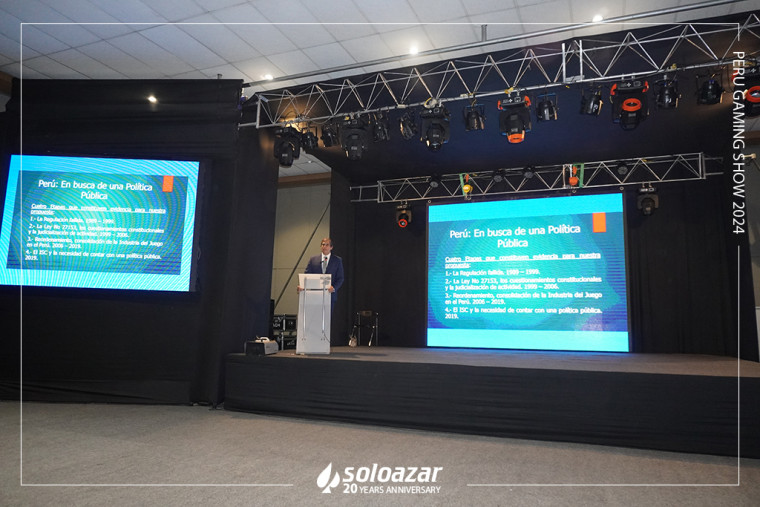
According to Dr. Traverso's opinion: "I think it was a very positive criterion of the legislator and it allowed for a solution to a real problem that arose, as it does in many other activities, when a commercial activity advances or develops much faster than the legislation".
Among the measures that accompanied this stage, Dr. Traverso points out the following:
-The criminal code is modified.
-The illegal operation of casinos and slot machines is penalised.
-Money laundering prevention regulations are established.
-The use of machines intended for minors is prohibited.
-The obligation of the online system is established.
-The unified real-time control system in force to date to provide a great deal of transparency and security to all businesses.
-The law on the prevention of gambling addiction.
“So these regulations complete a very stable, very technical legal framework, which allows for great growth in the casino and slot machine gaming industry”, Traverso added.
Challenges and Public Perception
Despite regulatory advances, public perception of the gaming sector remains a challenge. Dr. Traverso showed a report by the Ministry of Commerce, History and Tourism (Mincetur) revealing that only 5.9% of casino rooms and 15% of slot machine rooms were licensed, highlighting significant non-compliance with regulations. The press has played an important role in shaping this perception, underlining the need to improve the relationship with the media and the public.
Implementation of the Selective Consumption Tax
In 2018, the Executive approved Legislative Decree 1419, establishing an additional tax with a high rate that many consider unconstitutional. This tax is levied on business profits, negatively impacting industry. Congress' recommendation to repeal this decree has not been implemented, generating uncertainty and discontent in the sector.
Proposal for a Public Policy
The history of gambling regulation in Peru is clear evidence of the need for a coherent and stable public policy. The evolution of regulations has faced numerous challenges, from negative public perception to the implementation of controversial taxes.
In the face of these challenges, the need for a public policy on gambling that guarantees stability and legal certainty is evident.
Dr. Constante Traverso asks and answers in conclusion: "What are we looking for? Efficient, transparent governance, regulation at the service of development. What do we need to continue to offer society? More jobs, more investment, more tax revenue, but for that, what do we need? Legal certainty and stability, and that will only be achieved when the current selective consumption tax regime, which has been causing a lot of damage, a lot of harm to the activity, is corrected".
Categoría:Events
Tags: Peru Gaming Show,
País: Peru
Región: South America




Event
iGaming tech leader Cristina Turbatu commends ICE Barcelona's vision for Hall 7
Tuesday 20 Oct 2026 / 12:00
CGA Showcases Canada’s Competitive Edge at ICE Barcelona
Tuesday 13 Oct 2026 / 12:00
ICE Barcelona Hosts WorldGaming-Backed Nineball Championship in 2027
Tuesday 06 Oct 2026 / 12:00
SUSCRIBIRSE
Para suscribirse a nuestro newsletter, complete sus datos
Reciba todo el contenido más reciente en su correo electrónico varias veces al mes.