Tackling the unregulated iGaming market in Brazil at BiS SiGMA Americas
Monday 14 de April 2025 / 12:00
⏱ 4 min read
(São Paulo).- As Brazil’s iGaming sector matures, the challenges of sustaining a compliant, transparent, and profitable market have become increasingly pronounced. During the BiS SiGMA Americas 2025 summit, the panel titled “Financial Strategies to Combat the Unregulated Market and Protect Legal Operators”, hosted on the Jardins stage, delved into these complexities.
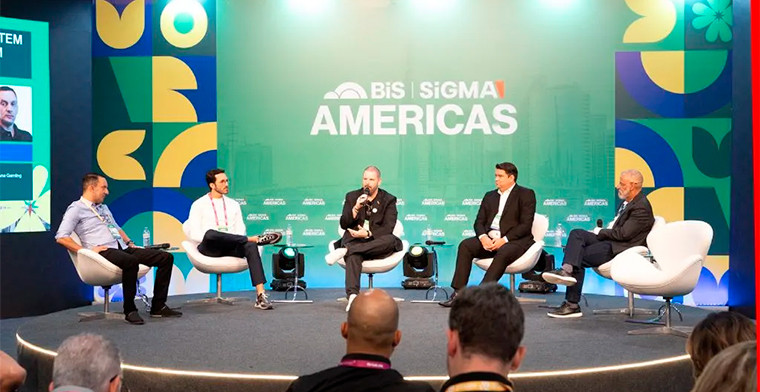
Bringing together a high-level panel of regulatory, financial, and operational stakeholders, the session delivered a candid and highly actionable discussion on how Brazil’s nascent regulated betting ecosystem must evolve to confront unlicensed competition.
Moderated by Magnho José, President of the Brazilian Institute for Legal Gaming (IJL), the session featured Fred Justo, General Coordinator for Money Laundering Monitoring and Related Matters at the Ministry of Finance; Leonardo Baptista, CEO of payment provider Pay4Fun; Ricardo Brito, Senior Director for Risk Professional Services LATAM at LexisNexis Risk Solutions; and Marco Tulio, CEO of Ana Gaming Group. Together, these panellists provided a granular breakdown of what financial and operational strategies are required to secure long-term viability for compliant operators.
The cost of playing by the rules
At the heart of the discussion was a shared frustration: regulated operators are absorbing considerable costs to operate legally, including licensing fees, tax burdens, and compliance infrastructure, yet face increasing competition from illicit platforms that bear none of these obligations. Marco Tulio highlighted this disparity by referencing the R$30 million spent on licensing, plus a further R$5 million in security deposits, underscoring the financial pressure on compliant businesses. While legal operators are aligned with public interest, ensuring tax returns and safer consumer experiences, they remain exposed to a market where unlicensed entities continue to lure players with fewer restrictions and inflated incentives.
The role of ordinance 566 and payment oversight
Fred Justo, reflecting on his tenure at the Secretariat for Prizes and Betting (SPA), pointed to Ordinance 566 as a meaningful first step in asserting regulatory control. This ordinance mandates payment providers to disclose their dealings with unlicensed operators, signalling the government’s intent to disrupt the financial underpinnings of the illegal market. However, Justo was unequivocal: blocking websites or issuing compliance notices alone would not suffice. The unregulated sector can only be effectively tackled through the disruption of its financial pipeline, particularly Brazil’s ubiquitous instant payment system, PIX. Without this, enforcement becomes performative rather than punitive.
Compliance infrastructure already in place
Leonardo Baptista expanded on this point, explaining that PIX, by design, provides an ideal infrastructure for traceability and anti-money laundering protocols. Tied directly to individual CPFs and regulated financial institutions, PIX already contains the operational architecture needed to identify and isolate illicit activity. However, he cautioned operators against partnering with payment providers offering low transaction costs without due diligence. As Baptista noted, “If you’re being offered a PIX fee of two cents, your provider is making money elsewhere. Cheap ends up being expensive.” He encouraged operators to perform thorough Know Your Provider (KYP) assessments, ensuring that cost savings are not being leveraged at the expense of compliance, cybersecurity, or redundancy.
Technology as an ally in fraud detection
Meanwhile, Ricardo Brito illuminated the increasingly sophisticated nature of fraud and identity theft in the iGaming space. From device spoofing and behavioural pattern cloning to bonus abuse driven by automated bots, illicit tactics are becoming harder to detect without robust, multi-layered risk management solutions. He advocated for a strategic outsourcing of these capabilities, suggesting that operators focus on their core business while entrusting fraud detection, data monitoring, and compliance automation to expert vendors. Brito reinforced the role of real-time data interpretation and behavioural biometrics in not only detecting fraud but also preventing the inadvertent facilitation of money laundering through platform loopholes.
Education, enforcement, and institutional blind spots
The conversation also touched on broader cultural and institutional hurdles. As Justo pointed out, many enforcement agencies, including local police and judiciary bodies, lack a fundamental understanding of how betting platforms operate, often misidentifying legal operators as complicit in manipulation or laundering schemes. He argued that alongside stronger regulation and enforcement, the government must prioritise education. Training for police officers, judges, and prosecutors on the inner workings of the betting industry is critical to reducing reputational damage and misdirected investigations.
Tulio echoed this need for public education but emphasised that operators also have a role to play. He called for a national-level campaign to monitor legal platforms and educate consumers about the dangers of engaging with unlicensed sites. This initiative would require alignment across operators, regulators, and marketing channels, including game suppliers and digital distribution platforms. Tulio was adamant that only a united effort from all stakeholders could dismantle the appeal of unregulated operators, who often offer higher bonuses and fewer restrictions but at the cost of consumer protection and financial security.
Aligning stakeholders under a common agenda
Throughout the panel, the consensus was clear: collaboration, not competition, must define the next phase of market development. There was a prevailing sentiment that legal operators, regulators, and payment facilitators must stop functioning in silos. Every part of the ecosystem, from app store access to game content provision, needs to be monitored to exclude unregulated participants. Baptista was particularly firm on the matter, insisting that financial institutions knowingly servicing illegal operators should face revocation of their licences. His view was unapologetically pragmatic: “Cut off the banking channel and the problem is solved.”
In conclusion, this panel offered more than just a review of current challenges, it set out a blueprint for immediate and long-term action. Legal operators must demand accountability not only from regulators but also from every partner in their operational chain. Governments must combine education with enforcement, empowering legal businesses to thrive in a level playing field. And above all, the market must embrace the reality that regulation is not an end but a process, one that requires vigilance, investment, and above all, unity.
Categoría:Events
Tags: SiGMA AMERICAS,
País: Brazil
Región: South America




Event










SBC Summit 2026
29 de September 2026
The Future of Sports Engagement Beyond the Court
Friday 16 Oct 2026 / 12:00
Ninja Gaming Focuses on Innovation and Global Growth After SBC Summit
Friday 16 Oct 2026 / 12:00
SBC Summit 2026 Wraps Up Record-Breaking Lisbon Edition
Thursday 15 Oct 2026 / 12:00
SUSCRIBIRSE
Para suscribirse a nuestro newsletter, complete sus datos
Reciba todo el contenido más reciente en su correo electrónico varias veces al mes.