Revenue Potential, Guardrails, and Competition from Prediction Markets
Lawmakers estimate that Washington, D.C. residents already wager around $1 billion a year on online games resembling mobile apps, including blackjack and live roulette. In a B2B context, this highlights a sizable, active player base currently operating outside a regulated local iGaming framework—an environment proponents describe as an unmonitored "black market" that leaves both players and public finances without oversight.
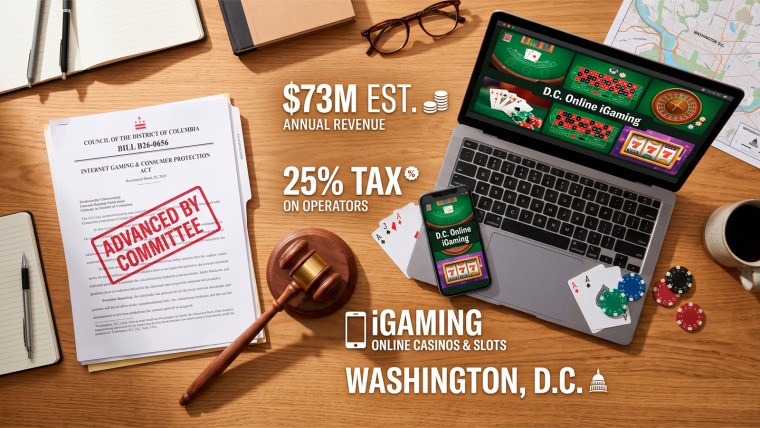
Facing an economic slowdown, supporters argue that legalization would bring up to $73 million in new tax revenue over four years while establishing formal regulatory guardrails. Council member Wendell Felder, who authored the bill, emphasized that the measure is designed to create a responsible framework rather than stimulate demand—incorporating provisions such as a credit card ban and a 21+ minimum age requirement.
The push also reflects broader market pressures across wagering verticals. Council members noted that consumers are increasingly targeted by alternative wagering formats, including prediction markets such as Kalshi. Because local authorities lack jurisdiction to regulate prediction markets directly, lawmakers view online casino legislation as a practical way to set enforceable rules on digital games of chance while competing with unregulated or adjacent betting channels.
Committee Vote, Union Live-Dealer Jobs, and Wider Expansion Signals
The proposal cleared D.C.'s Human Services Committee by a 3–1 vote and now heads toward a full D.C. Council vote in the coming weeks. The single dissenting vote came from Council member Christina Henderson, who pointed to data linking expanded online betting to higher bankruptcy risks and questioned relying on gambling revenue amid addiction concerns.
For operators and studio suppliers, a notable operational detail in the bill is its live-dealer requirement: games must feature real employees streaming themselves dealing cards to online players. Committee estimates project this provision will generate roughly 100 union jobs, with support from Unite Here Local 25, whose treasurer Paul Schwalb noted the bill would create unionized roles and fund public programs for working families.
The bill fits into a gradual opening of D.C.'s wagering landscape. Following the 2024 expansion of sports betting and Mayor Muriel Bowser's unsuccessful 2025 push to legalize live poker as part of a broader entertainment revenue strategy, momentum around regulated gaming continues to build. Council member Robert White—D.C.'s incoming congressional delegate—has also expressed openness to revisiting federal restrictions on casinos in the capital, signaling that regulatory evolution in the district may extend beyond online casino games over time.