Kansas sportsbooks future faces unexpected headwinds
Monday 14 de April 2025 / 12:00
⏱ 3 min read
(Kansas).- The sports betting industry in Kansas is facing significant and unexpected uncertainty, following a legislative decision that could potentially result in the closure of the state’s six operational sportsbooks by 2027.
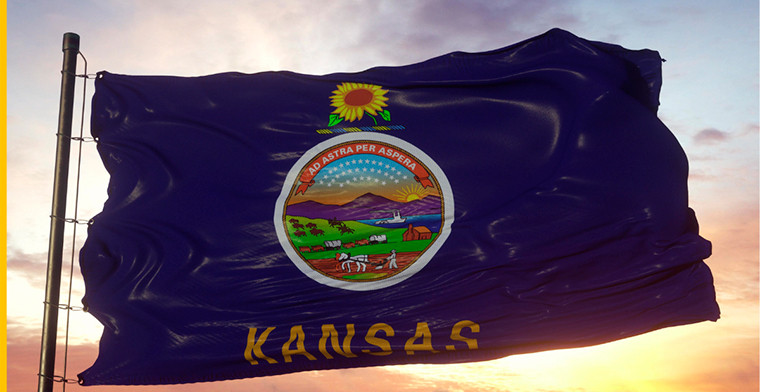
A provision has been included in a state budget bill to prevent the renewal of the sportsbooks’ licences. This could effectively end Kansas’ current regulatory model, unless lawmakers take future action to revise or extend the system.
In the meantime, the six sportsbooks currently operating in Kansas — BetMGM, Caesars, DraftKings, ESPN Bet, Fanatics, and FanDuel — will retain their licenses until 31 August, 2027.
However, under the new law regulators are barred from renewing those licences once they expire, unless a new legal framework is introduced.
This does not immediately halt legal betting in Kansas, but creates a future deadline beyond which sportsbooks could be forced to stop accepting wagers.
The restriction on licence renewals stems from a budget provision that was initially vetoed by Gov. Laura Kelly earlier this year.
However, some lawmakers in the state legislature voted to override that veto as part of a broader package addressing multiple vetoed provisions.
The Kansas House narrowly failed to override the veto on Thursday (10 April) but succeeded in a subsequent vote on Friday, pushing the measure through.
Although the new law does not outlaw sports betting outright, it introduces substantial instability into a market that was previously considered secure.
Lawmakers want more revenue
The original 2022 legislation to legalise sports betting in Kansas allowed for up to 12 sportsbooks, each required to partner with one of the state’s four land-based casinos, which are managed by the state lottery.
These partnerships created a competitive and relatively low-tax environment for operators, with a 10% tax rate on revenue — one of the lowest in the nation.
The decision to prevent licence renewals appears to be driven, at least in part, by dissatisfaction among some legislators with the revenue being generated under the current tax structure.
Analysts have noted that this move could pave the way for a more restrictive regulatory model.
Sources familiar with the legislative process have indicated that some lawmakers are considering a shift toward a single-operator or limited-operator structure, similar to the now-defunct monopoly model once used in Washington DC.
This prospect has raised concerns among industry stakeholders, who argue that limiting operator access typically leads to lower tax revenues and increased offshore betting activity.
Data from various states indicate that jurisdictions with only one licensed sportsbook operator tend to generate significantly less per-adult revenue compared to those with multiple options.
For example, states with a single-operator model averaged $45 per adult in revenue in 2024, while states with four or more operators averaged $92.
Citizens JMP analyst Jordan Bender highlighted that such policy changes introduce volatility into what was thought to be a stable market.
He noted that moves like these complicate the forecasting of state legislative outcomes and can negatively impact investor confidence in the broader gaming sector.
Bender emphasised that limiting competition in pursuit of higher tax revenue is often counterproductive, as higher tax burdens or fewer choices tend to drive consumers toward unregulated offshore markets.
2026 will be key year for sports betting
The current prohibition on licence extensions expires on 30 June 2026, which means Kansas lawmakers will have an opportunity to revisit the issue during the 2026 legislative session.
If no new legislation is passed by then, the Kansas Racing and Gaming Commission would theoretically be able to resume licence renewals.
However, lawmakers could also choose to extend the prohibition, perpetuating the uncertainty surrounding the state’s sports betting industry.
No new sports betting reform bills have been introduced yet, and with the 2025 legislative session now closed, there will be no immediate changes to the regulatory framework.
Still, the recent developments suggest that Kansas’ current competitive sportsbook model is at risk and could be significantly altered in the coming years, depending on the direction lawmakers take during the 2026 session.
For now, bettors in Kansas can continue placing legal wagers through the six active sportsbooks. But the long-term future of legal sports betting in the state remains
Categoría:Sportsbook
Tags: Sin tags
País: United States
Región: North America




Event







SBC Summit 2026
29 de September 2026
Uplatform Brought "Your Dreams. Our Platform" to Life at SBC Summit Lisbon 2026
Friday 09 Oct 2026 / 12:00
Kambi Highlights Network and LatAm Growth at SBC Summit
Friday 09 Oct 2026 / 12:00
GR8_TECH Highlights Speed and Growth at SBC Summit 2026
Friday 09 Oct 2026 / 12:00
SUSCRIBIRSE
Para suscribirse a nuestro newsletter, complete sus datos
Reciba todo el contenido más reciente en su correo electrónico varias veces al mes.