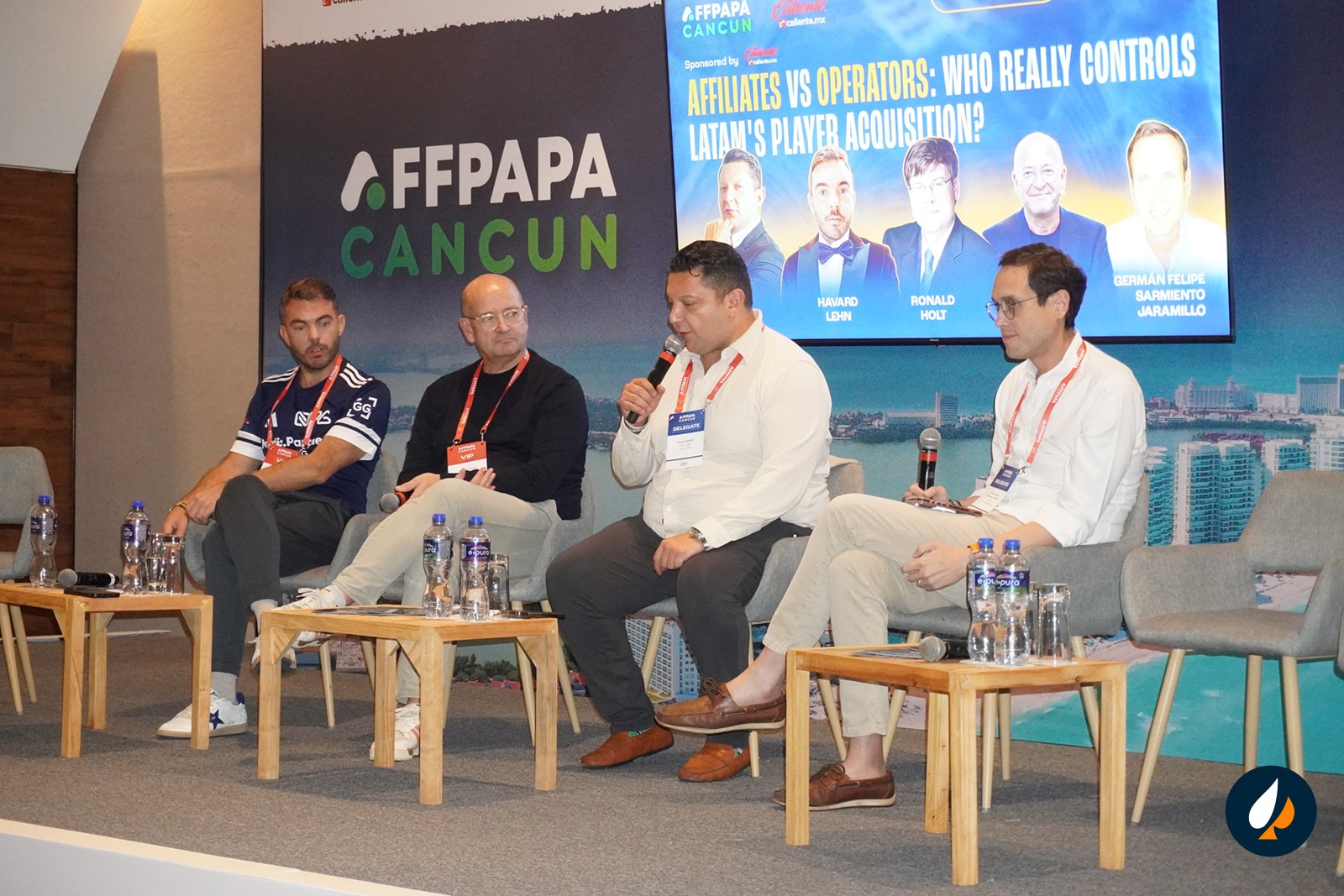
From the opening of the Affiliates vs. Operators: Who Really Controls LatAm's Player Acquisition? panel, the discussion pitted the perspective of SEO affiliates against the view of brand-led operators in the region. For Ditsche, the commercial relationship remains that of a vendor and a client, though marked by a structural asymmetry in measuring results.
"We are an SEO affiliate, and that means we own the traffic up to the moment we send it to the operator; there we lose control because we depend on the client to transparently report our revenue," said Ditsche, highlighting the industry's longstanding concern over reporting reliability and retention.
On the operator side, Sarmiento Jaramillo—who previously worked at Mexican market firms such as NetBet and MaxBet before joining Betcris—argued that initial acquisition does not guarantee business without a solid operation behind it. Drawing on figures for Mexico, he noted that the country has 118 million inhabitants, of whom 92 million are over 18 and around 40% show an affinity for gaming, representing a potential pool of nearly 40 million people compared with roughly 7 million already playing online.
For Sarmiento Jaramillo, that gap of 33 million potential users shows that control over traffic lies with whichever side can sustain long-term demand through payment methods, customer service, and brand building: "The user's final decision rests on what the operator can offer; without tools and synergy between affiliates and operators, traffic is lost."
Regulated Markets, RevShare vs. CPA, and Responsibility
Regulatory progress in Brazil, Ecuador, and Chile, alongside the consolidation of markets such as Colombia and Mexico, sparked debate over compensation models and the ethical role of affiliation. Ditsche explained that iGaming.com chose to work exclusively with licensed operators in each jurisdiction, prioritizing revenue share (RevShare) agreements to support teams of hundreds of employees against the volatility of pure CPA.
Comparing regulatory approaches, Ditsche questioned why European markets like Germany ban RevShare on the grounds that it makes affiliates overly aggressive, when in practice CPA forces them to push for daily volume. He also warned that excessive restrictions in the legal market push players toward unlicensed operators: "When an affiliate decides to promote only legal operators, they lose a lot of traffic, and some of those users end up on the black market—without protection, taxes, or oversight."
In response, Sarmiento Jaramillo emphasized that regulatory compliance and responsible gaming require shared alignment among operators, affiliates, and influencers, and criticized the saturation of bonus-focused ads during televised sports broadcasts: "Final responsibility toward the customer lies with the operator, but the affiliate is a strategic partner that must align its communication and reviews with the regulated message." He also noted that across several operations he led, more than 50% of the commercial strategy relied on affiliation.
Streamers, Esports, and the Future of the Partnership Toward 2031
Another central theme of the session was the rise of streamers, content creators, and esports teams compared with traditional SEO. Asked whether these players pose a threat to classic affiliation, Lehn dismissed that idea and stressed that the industry demands constant adaptation.
As an example of that evolution at Nordic Partners, Lehn highlighted active work with live creators and the recent acquisition of an esports team to diversify audience sources and monetization. In his analysis, SEO affiliates capture demand from users looking to research and play (pull marketing), while streamers and influencers drive push marketing strategies that affiliates must adopt to stay competitive.
Ditsche agreed with that assessment and warned that relying exclusively on SEO over the next five years would leave any affiliate obsolete, comparing the shift to moving from traditional brand ambassadors to digital creators able to connect with new audiences.
Closing out the panel and looking ahead five years, Sarmiento Jaramillo anticipated closer, more transparent integration over which channels and influencers each partner uses to benefit the brand. Meanwhile, Lehn summed up the essential condition for innovating in the sector: "To stay relevant, we need data transparency." Finally, Ditsche predicted that affiliates will remain relevant as partners sharing commercial risk, though purely informational formats will give way to community- and storytelling-driven approaches.