Patolli to Digital: Mexico’s Gambling Tradition from Aztec Times to Today
Wednesday 29 de October 2025 / 12:00
⏱ 3 min read
(Lisbon).- Mexico’s gaming tradition predates the rise of modern casinos. Dating back to the Aztec era, games like Patolli—played with painted beans on a cross-shaped board—captivated players who bet items like cloaks and stones. Over the centuries, the country has navigated prohibitions, lotteries, and evolving regulations. Today, that same spirit thrives through mobile apps and digital platforms. This article by Atlaslive explores the thread that links Mexico’s ancient past to its high-tech present.
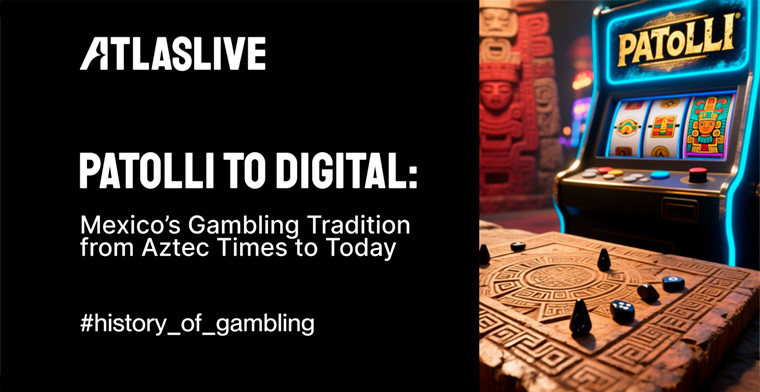
Patolli to Digital: Mexico’s Gambling Tradition from Aztec Times to Today
Mexico has been a gaming country longer than casinos have existed. In Aztec times, Patolli sent painted beans around a cross-shaped board while onlookers wagered cloaks and stones. Centuries of bans, lotteries, and regulation followed; now the action lives on phones and online platforms. In this article, we connect those eras.
Patolli—The Aztec Game of Fate
Patolli was one of the Aztecs’ most popular games of chance.
Players used beans marked with dots as dice, moving pieces around a cross-shaped mat. Wagers often included blankets, jewels, or food, and nobles were frequent participants.
The game carried both social and spiritual meaning, reflecting the Aztecs’ belief that fate was tied to cosmic order.
Colonial Era to 19th Century: Prohibition and Lotteries
After the Spanish conquest, gambling faced restrictions under Catholic influence. Despite bans, games persisted in taverns and local gatherings. To channel betting in a controlled way, colonial authorities introduced lotteries, which became a lasting fixture of Mexican culture.
Gambling continued as a tolerated but often underground activity.
20th Century: Casinos, Politics, and Bans
The early 1900s saw casinos flourish, especially in border towns that attracted international visitors. Political shifts soon brought crackdowns, culminating in the 1947 Federal Gaming and Raffles Law (Ley Federal de Juegos y Sorteos) that tightly restricted operations. State lotteries and betting on traditional activities like cockfighting survived, but most casinos were shut down, pushing much of the activity into informal spaces.
Modern Regulation: Federal Law and Online Expansion
Today, gambling in Mexico is regulated by the Federal Gaming and Raffles Law of 1947, with its application detailed in the Reglamento published in 2004 under the Ministry of the Interior (SEGOB). Licensed land-based casinos and sports betting shops operate under these rules with federal permits. Online gaming, however, is not explicitly covered by the 1947 law, leaving it only partially regulated.
From Patolli to Platforms: What Stays the Same
Strip away mats, reels, and code, and the pattern repeats. A community forms around chance; value changes hands; authority sets the boundaries; players read meaning into runs of luck.
In Patolli, nobles wagered cloaks and food before an audience; today, balances and bonuses are placed before streams and chats. The format changed, but the social role of gambling—risk shared and witnessed—endures.
The mechanics shifted from beans to algorithms, yet the rhythm is familiar: anticipation, reveal, resolution. Players still seek patterns in luck, and designers still shape the arc of suspense.
Oversight has also been a constant. Rituals once set the rules; colonial authorities imposed bans; modern regulators enforce licensing and payments compliance. Trust remains central—then as now, the game is only as strong as the guarantee that it is fair.
From mats to mobile apps, gambling reflects its era. The appetite for measured risk never disappeared; it simply found new tools and new arenas.
Conclusion
From Patolli beans cast on a woven mat to today’s wagers placed on mobile apps, Mexico’s gambling story shows remarkable continuity. The forms have changed, but the appetite for risk, the search for fairness, and the role of regulation remain constant.
As lawmakers prepare to update an aging framework, Mexico stands at the threshold of a new chapter—one where centuries of tradition meet the demands of a digital economy. For operators and players alike, the next moves will shape the market and the legacy of gambling in Mexico.
Categoría:Gaming
Tags: atlaslive,
País: Portugal
Región: EMEA




Event










SiGMA North America 2026
01 de September 2026
LatAm Regulators Discussed Illegal Gambling and Innovation at SiGMA North America
(Mexico City, SoloAzar Exclusive).- The panel "The Red Pen Forum: Regulators Respond to the Industry," held during SiGMA North America 2026, brought together representatives from Uruguay, Argentina, Puerto Rico, and Honduras to analyze regulatory challenges, digital transformation, illegal gambling, and the need to adapt lotteries for new generations. The conference was moderated by Rodrigo Cigliutti, Executive Director of CIBELAE (Ibero-American Corporation of State Lotteries and Betting), and featured the participation of Marcelo Visconti, National Director of Lotteries and Quinielas of Uruguay; Carlos Moyano, President of IAFAS Entre Ríos, Argentina; Heidi Hernández Olivo, Deputy Secretary of the Puerto Rico Lottery; and Lissa Mencía, General Director of Lottery Operations and Games at Loto Honduras.
Monday 28 Sep 2026 / 12:00
SiGMA North America Addressed Crisis Management in iGaming
(Mexico, SoloAzar Exclusive).- During SiGMA North America 2026, Rosa Ochoa, founder of the Blue Global Gaming platform and strategic advisor for gaming operators; Iliana María Pineda Echeverri, Chief Legal & Compliance Officer at Wplay.co; Iraid Rosales, Country Manager Mexico at Amusnet; and Elizabeth Maya Cano, Executive President of CORNAZAR, analyzed the key factors in managing crisis situations within the iGaming industry, with a special focus on transparency, communication, technology, and preparation.
Friday 25 Sep 2026 / 12:00
Affiliates and Acquisition: Keys to Regulated Markets in North America
(Mexico City, SoloAzar Exclusive).- During SiGMA North America 2026, Cristopher Guzmán Reyes, Head of Affiliates at Logrand Entertainment Group; Guga Júnior, influencer and slots expert at Scalar Partners; Andrés Gómez, Head of Latin America Go-to-Market Strategy at Admattic; Yambot Aguilera, Gaming and Finance Sales Director at Google; and Paula Gabriel Jiménez, Advertising Client Growth Director for Microsoft at Aleph, analyzed the state and provincial affiliate ecosystem in North America, as well as the acquisition challenges in regulated markets.
Thursday 24 Sep 2026 / 12:00
SUSCRIBIRSE
Para suscribirse a nuestro newsletter, complete sus datos
Reciba todo el contenido más reciente en su correo electrónico varias veces al mes.