Interviews
Chilean Casino Tender Sees Lower-Than-Expected Turnout
2 minutos de lectura
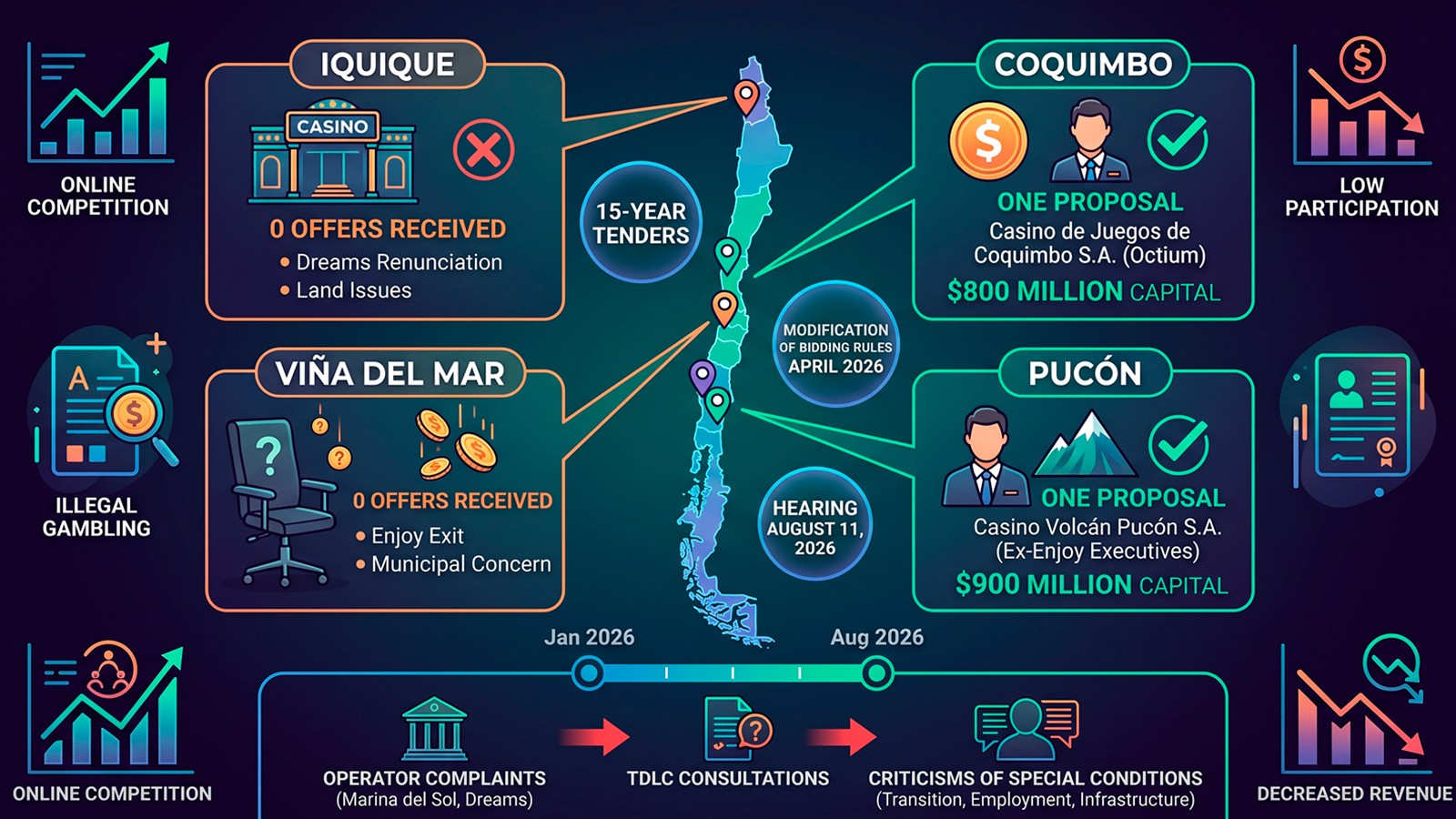
(Santiago de Chile, SoloAzar Exclusive) — The bidding process for four casino operating permits in Chile has seen surprisingly low participation, falling short of both regulator and industry expectations. Viña del Mar and Iquique failed to attract any bidders, while Coquimbo and Pucón received just one proposal each. This outcome reignites scrutiny over the tender's economic and technical requirements, following months of pushback from operators and an antitrust review.
Four permits up for grabs amid low turnout
The Superintendence of Gaming Casinos (SCJ) began in January 2026 the processes to grant new operating permits in Iquique, Coquimbo, Viña del Mar and Pucón, after the companies that until then operated these places renounced their respective permits.
The four tenders contemplate operating permits for 15 years and constitute one of the most relevant renewal processes for the Chilean face-to-face industry. The hearing for the presentation of technical and economic bids had initially been expected to be scheduled for July, but the SCJ modified the bases in April and extended the deadline by 12 working days, finally setting the hearing for August 11, 2026.
The result of that instance, according to the background published by Chilean media, was uneven: there were no applicants for Viña del Mar or Iquique, while Coquimbo and Pucón were left with only one bidder each. In terms of competition, this means that none of the four places reached a situation of effective competition between multiple projects.
The scenario is particularly relevant for the SCJ, since one of the declared objectives in extending the deadlines had been precisely to give more time to interested parties to prepare their proposals and promote competition.
Coquimbo and Pucón Receive the Only Bids
The two positions that did manage to attract applicants also have different profiles.
In Coquimbo, the private investment fund Octium, managed by Alza, had set up the company Casino de Juegos de Coquimbo S.A., with a capital of $800 million, specifically aimed at participating in the process.
In Pucón, on the other hand, Casino Volcán Pucón S.A. was incorporated, a company linked to a group of former Enjoy executives. The company was created with a capital of $900 million and aims to operate the gaming casino of the commune.
The situation is especially significant because both Coquimbo and Pucón had been operated by Enjoy, which in 2025 obtained authorization to renounce both permits early. The regulations establish that the resigning company and its business group cannot directly reapply for the quota they renounced.
Viña del Mar and Iquique: The Most Complex Markets
The absence of bids in Viña del Mar and Iquique is the main indicator of the difficulties faced by the current design of the process.
In the case of Viña del Mar, the challenge has an additional dimension due to the economic weight of the casino for municipal and regional finances. The departure of Enjoy opened a process aimed at replacing the operator, but also generated concern regarding the ability of a new concession to maintain the levels of economic contribution recorded during the previous operation.
Already during 2025, specialists had warned that market conditions made it unlikely to repeat the economic offer of 831,000 UF made by Enjoy in 2018. An analysis commissioned by the municipality subsequently placed a more realistic range between 605,000 and 670,000 UF, in a context also marked by competition from online gambling platforms and illegal gambling.
In Iquique, the situation is also linked to the departure of Dreams. The company renounced the permit after part of the land planned for the development of the project was declared a historical monument, while the SCJ authorized the waiver under the mechanism established by the regulations.
Operators question the certain conditions
The low turnout follows a crackdown by the incumbent major operators against certain aspects of the process.
Marina del Sol filed a consultation with the Court for the Defense of Free Competition (TDLC) to analyze whether the bases of the four tenders could unjustifiably limit competition. Dreams later joined the questions and requested to suspend the processes while their objections were analyzed.
One of the most discussed points has been the design of the transition conditions between the outgoing operator and the new successful bidder. In the case of Viña del Mar, Marina del Sol particularly questioned the three-month deadline foreseen for the start-up of the new project, arguing that certain conditions could favor the incumbent operator.
Dreams, for its part, questioned demands related to job continuity, tourism infrastructure works and the obligation to incorporate personnel, pointing out that these conditions could increase the risks of the projects and reduce the number of operators willing to participate.
The TDLC kept the process open
The controversy reached the TDLC, but it failed to definitively stop the calendar.
In July, the court decided not to maintain the suspension of the process of granting the Viña del Mar permit requested by Inversiones Marina del Sol. The SCJ held that there was insufficient evidence to presume a serious impact on free competition and argued that a suspension could reduce participation by shortening the period available to prepare and implement projects.
The National Economic Prosecutor's Office also intervened in the analysis of the situation. In the case of Viña del Mar, the FNE indicated that it did not notice barriers in the bases of the process, while the debate before the TDLC remained open for the presentation of background information.
Therefore, the process reached the presentation of offers without regulatory questions having caused its paralysis.
A tender that tests the Chilean model
The small number of offers transforms the result of August 11 into something more than an administrative instance. For the industry, it is a sign of the current attractiveness of the Chilean model of concession of land-based casinos.
The former superintendent of Gaming Casinos Francisco Leiva had warned before the closing of the process that the tender "is destined to fail", arguing that the so-called Special Conditions could severely limit competition and indirectly favor companies related to operators that had renounced their permits.
The results known so far provide elements to evaluate this diagnosis, although they do not allow us to conclude on their own that the bases are the only cause of the low participation. The Chilean land-based market is simultaneously facing changes in demand, competitive pressure from online gambling, financial difficulties for some operators and greater demands for investment, employment and infrastructure.
In this context, the challenge for the regulator will be to determine whether the bids received allow progress towards economically sustainable awards or whether, on the contrary, the lack of competition may end up being reflected in less favorable economic conditions for the State, regional governments and municipalities.
The next step: technical evaluation and award
The submission of bids does not yet imply the awarding of permits. From this instance, the evaluation of the projects begins, a process in which legal, regulatory, financial and technical aspects are reviewed before the Resolution Council of the SCJ adopts the corresponding decisions.
The experience of previous processes shows that the technical evaluation is a substantive stage: it includes the verification of legal and regulatory requirements, special conditions, origin and sufficiency of funds and the comprehensive evaluation of the project.
The critical point will now be to determine if the projects presented in Coquimbo and Pucón meet the established requirements and can sustain the investments and obligations committed, while Viña del Mar and Iquique are left with a much more uncertain scenario as they have not received offers.
The Dilemma for the Casino Industry
The Chilean tender thus leaves a photograph with two readings. On the one hand, the SCJ managed to maintain the calendar despite judicial and regulatory questions and managed to receive projects for two of the four positions. On the other hand, the fact that two major markets have run out of applicants and the other two have only one bidder is evidence of much less competition than would normally be expected in a process aimed at selecting operators for 15-year permits.
For Chile, the result opens up a fundamental question: are the conditions designed to ensure greater investments, job continuity and tourism benefits generating a sufficiently attractive framework for new operators?
The response will have an impact not only on the four concessions currently in dispute, but also on the future design of casino tenders in the country and on the capacity of the Chilean regulatory model to combine revenue, investment, tourism development and effective competition in the land-based market.
Categories: Exclusive
Tags: No Tags
Region: Europa
Sign Up
To subscribe to our newsletter, please fill in your details
Receive all the latest content in your email several times a month.