"Regulation of Remote Gaming and Remote Sports Betting in Peru": Conference at PGS 2025
⏱ 4 min read
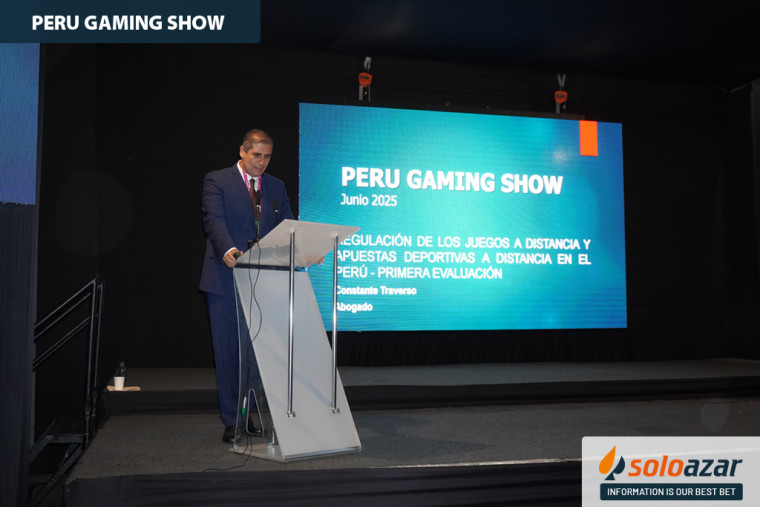
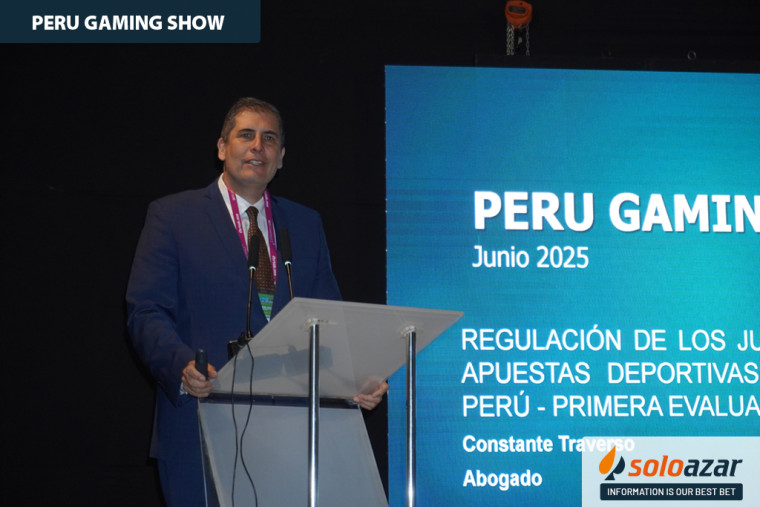
(Lima, SoloAzar Exclusive).- Peru Gaming Show 2025 was once again the scene of valuable conferences on the present and future of Gaming within the Latam region. In this context, the lawyer and specialist in corporate and regulatory law, Constante Traverso was the speaker at the conference that gives title to this article, where he presented a critical look at the legal, tax and compliance aspects that affect the sector, as well as its benefits and sustainable development.
First figures: the weight of a consolidated industry
At the beginning of his presentation, lawyer Constante Traverso highlighted the economic and social impact that the gaming sector has had in Peru for more than three decades. ‘The tradition of gambling in Peru is already more than 30 years old and it has been a real success, bringing many benefits and prosperity’, he said.
As for the most representative data, and in terms of investment, he cited an estimated figure of 700 million dollars in 2019, the product of a joint study with Mincetur.
On taxation, he indicated that the sector contributed around 300 million soles annually through special taxes. ‘Although it represents only 0.2% of national revenue, it is comparable to taxes such as the ITF or the RUS,’ he said, noting that gaming revenues directly finance key institutions such as Mincetur, the Peruvian Sports Institute and the Ministry of Health.
Traverso also highlighted the work of Mincetur and the importance of its investment in Peru's tourism.
Legal framework for remote gambling: progress and challenges
In addressing the central axis of his presentation, he presented a tour of the legislative process that gave rise to the regulation of sports betting and remote gambling in Peru. ‘This is a project that was born, it could be in 2017 or 2018, and that was maturing within the Directorate of Casino Games of the Mincetur, with a very skilled and committed technical team,’ he remarked.
The speaker recalled that, after sustained work, the first law on sports betting and remote gaming was approved on 13 August 2022. Months later, adjustments were made to the text and, finally, in September 2024, the regulation was enacted, which ‘maintains international standards and responds to a technical logic’, said. He praised the work of Mincetur as a regulator: ‘We consider it to be one of the best in the region’.
However, he also pointed out some specific criticisms of the current regulations, such as the high level of requirements to enter the market:
‘A guarantee regime of 600 UITs is established to operate remote gambling, which has become a barrier to entry for many companies’.
Taxes and regulatory excesses in debate
‘The central part of my presentation will focus on consumption,’ said Traverso, referring to the new tax approved by the executive branch, outside the original design of the law. He explained that this tax was not contemplated in the current terms in the initial project, and its application ‘is causing a lot of damage to the operation, so we hope that it will be corrected soon’.
He also questioned the regulatory instability affecting the sector: ‘Since the first law in 2022 until today, eight projects have already been presented in Congress, most of them without technical support, which only generate uncertainty and slow down investment’.
Despite these difficulties, the lawyer highlighted the process of implementing the law as a ‘tremendous success’, acknowledging the technical work of the Mincetur's Gaming Directorate. ‘The deadlines were short, but they were excellently met,’ he said, and detailed that to date, 108 authorisations have been granted to operate gambling:
- 108 authorisations to operate gambling
- 4,699 registered betting parlours
- 88 approved gaming platforms
- 294 linked services programmes
- 551 gaming programmes and 331 modalities, including live casinos and progressive systems
All these procedures, he said, were carried out digitally through a platform developed by Mincetur's own management.
Another significant fact given by the speaker was that in April and May, revenue from sports betting and remote gaming already surpassed that of casinos and slot machines.
For Traverso, this market behaviour confirms the growing importance of online gambling, but also underlines the urgency of adjusting the tax framework to avoid distortions that ‘make the operation unviable’.
Critical closure: tax burden and lack of legal certainty
Finally, Traverso insisted that the main obstacle to the development of online gambling in Peru is the disproportionate tax structure.
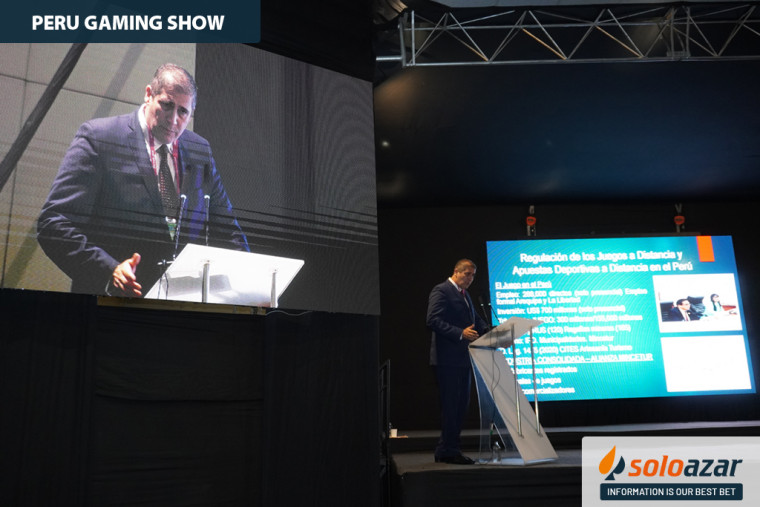
"Taxing the tax base on the stake, instead of the net income, is a technical nonsense. The same amount of money can circulate and multiply in bets, but it is still the same initial investment".
He also stressed that the inability to deduct bonuses and promotions such as welcome bonuses creates an unnecessary cost overrun for operators.
Added to this is an environment with a high tax burden, legal uncertainty and a state policy aimed at discouraging gambling, which according to the lawyer ‘has no legal or constitutional basis’.
"They accept that taxes are confiscatory, but argue that they seek to discourage gambling. We are licensed operators, evaluated, and yet we have to face this kind of policies".
Proposal
Traverso concluded his presentation by highlighting the social role of the sector in supporting more than 260,000 families, which, he said, ‘must be taken into account when designing a fairer and more sustainable tax system’. He also highlighted the key role played by MINCETUR as a strategic ally to achieve the implementation of public policies that promote an adequate regulation of gambling, recognising it as a legitimate form of entertainment for the Peruvian people.
Relive PERU GAMING SHOW 2025 experience with SoloAzar's social media coverage and exclusive interviews. Follow us on LinkedIn and Instagram to stay in the loop!
Categoría:Events
Tags: PGS, Peru Gaming Show,
País: Peru
Región: South America




Event







SiGMA North America 2026
01 de September 2026
LatAm Regulators Discussed Illegal Gambling and Innovation at SiGMA North America
(Mexico City, SoloAzar Exclusive).- The panel "The Red Pen Forum: Regulators Respond to the Industry," held during SiGMA North America 2026, brought together representatives from Uruguay, Argentina, Puerto Rico, and Honduras to analyze regulatory challenges, digital transformation, illegal gambling, and the need to adapt lotteries for new generations. The conference was moderated by Rodrigo Cigliutti, Executive Director of CIBELAE (Ibero-American Corporation of State Lotteries and Betting), and featured the participation of Marcelo Visconti, National Director of Lotteries and Quinielas of Uruguay; Carlos Moyano, President of IAFAS Entre Ríos, Argentina; Heidi Hernández Olivo, Deputy Secretary of the Puerto Rico Lottery; and Lissa Mencía, General Director of Lottery Operations and Games at Loto Honduras.
Monday 28 Sep 2026 / 12:00
SiGMA North America Addressed Crisis Management in iGaming
(Mexico, SoloAzar Exclusive).- During SiGMA North America 2026, Rosa Ochoa, founder of the Blue Global Gaming platform and strategic advisor for gaming operators; Iliana María Pineda Echeverri, Chief Legal & Compliance Officer at Wplay.co; Iraid Rosales, Country Manager Mexico at Amusnet; and Elizabeth Maya Cano, Executive President of CORNAZAR, analyzed the key factors in managing crisis situations within the iGaming industry, with a special focus on transparency, communication, technology, and preparation.
Friday 25 Sep 2026 / 12:00
Affiliates and Acquisition: Keys to Regulated Markets in North America
(Mexico City, SoloAzar Exclusive).- During SiGMA North America 2026, Cristopher Guzmán Reyes, Head of Affiliates at Logrand Entertainment Group; Guga Júnior, influencer and slots expert at Scalar Partners; Andrés Gómez, Head of Latin America Go-to-Market Strategy at Admattic; Yambot Aguilera, Gaming and Finance Sales Director at Google; and Paula Gabriel Jiménez, Advertising Client Growth Director for Microsoft at Aleph, analyzed the state and provincial affiliate ecosystem in North America, as well as the acquisition challenges in regulated markets.
Thursday 24 Sep 2026 / 12:00
SUSCRIBIRSE
Para suscribirse a nuestro newsletter, complete sus datos
Reciba todo el contenido más reciente en su correo electrónico varias veces al mes.