The World Cup as a Stress Test: What 90 Minutes of Live Betting Reveals About Your Platform
Tuesday 14 de July 2026 / 12:00
⏱ 7 min read
Drawing on his experience leading the development of technology platforms for the online gaming industry, Fernando Polti, Founder & CEO of Wizards, examines how the FIFA World Cup 2026 will put sports betting operators' infrastructure to the ultimate test. In this opinion piece, he explains why the real challenge will not be attracting more users, but responding with precision and stability to the extreme peaks in live betting activity that will determine the performance of every platform.

Everyone watches the match. I watch the load graph. Occupational damage, sure. But it's also where you find out who cashes in and who spends Monday apologizing.
89th minute. The goal goes in. The stands erupt over one thing; your backend erupts over another. A vertical spike that multiplies your traffic tenfold in under two seconds. Tens of thousands of sessions demanding fresh odds in the same millisecond. A market that was alive three seconds ago and is now worth zero. And a settlement queue you have to clear before the referee waves for the kickoff.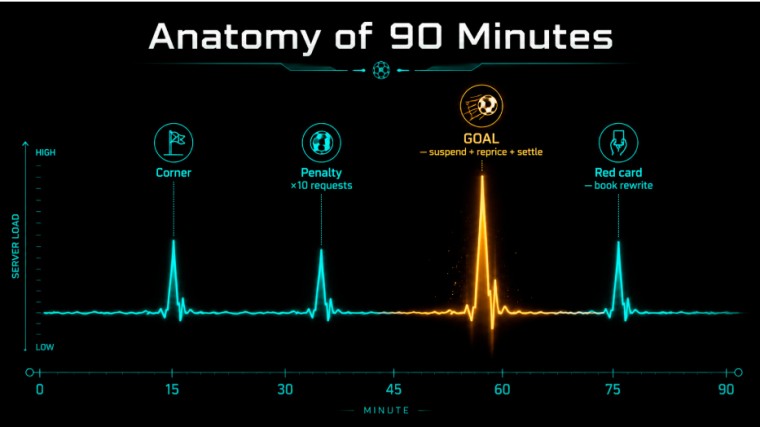
That half-second is not won by whoever ran the best Instagram campaign. It's won by whoever built the best engineering. Full stop.
The 2026 World Cup is the largest betting event in history. No asterisks. Estimates point to roughly $50 billion wagered globally, and more than $3 billion in the United States alone — the first World Cup with a regulated North American market that is massive and starving. The entire industry reads that number as an opportunity.
I read it differently. It's the most brutal audit your platform will face in four years. A pass-or-fail exam, taken live, with half the planet as witnesses.
And most operators won't pass it. They just don't know it yet. Nobody has pushed them to the breaking point. The World Cup will.
The World Cup Doesn't Bring You Users. It Brings You Load.
Get this straight: a match is not traffic. It's a sequence of detonations.
The first twenty minutes lie to you. All quiet. Then the first dangerous corner arrives and the "next goal" market shudders. A penalty awarded multiplies your requests tenfold in two seconds. A goal does it again, only worse: now you also have to suspend markets, reprice the entire book, and settle everything that goal just resolved — before you reopen. A red card rewrites the whole match's probabilities in one stroke.
This is not a Black Friday peak, with demand climbing a gentle curve across hours. This is a heart monitor. And your architecture has to be built for the most violent beat, not the average one.
The operator who sizes his infrastructure around a match's average traffic is building a levee to the height of the river in the dry season. By the time the real flood comes, it's too late to order concrete.
The Three Places Your Platform Splits Down the Middle
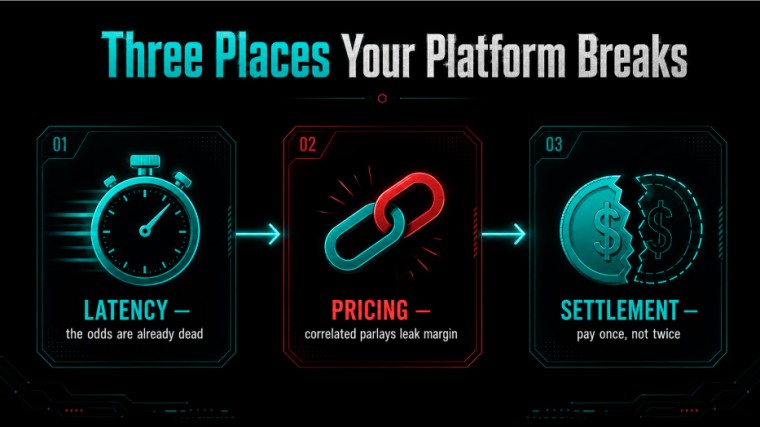
1. Latency: The Odds You're Showing Are Already Dead
Live, an odds price is a perishable product. It lives for milliseconds, then it rots.
The feed detects the event. Your engine recalculates. The new price travels to the screen. The user taps. The bet returns to the server. Every hop adds latency. And all the while, the match didn't wait for you. If your pipeline takes 800 milliseconds end to end, you're selling the player a price for a match that no longer exists.
Two ways to lose, and both hurt. One: you over-armor, suspend at the slightest doubt, and the user eats "bet unavailable" exactly when they wanted in. Goodbye retention. Two: you leave the window open too long and hand latency arbitrage to the sharp betting against a dead price. Goodbye money — cash, straight from your pocket into his.
The midpoint between those two deaths is not a business problem. It's low-latency engineering: event-driven architecture, in-memory pricing, and queues that don't clog when the tsunami hits. If your answer to this is "we'll look into it with the provider," you've already lost.
2. Pricing: The Same-Game Parlay Is a Money Machine… Until It Turns on You
The same-game parlay — bundling several markets from one match into a single ticket — is the flagship product of this World Cup. And for good reason: it inflates your margin, and the player falls in love with a big payout for pocket change. Candy for both sides.
Until you remember one detail: those markets are correlated. And that's where the people who know split from the people who copy-pasted. "Messi scores" and "Argentina wins" are not independent: if one happens, the other becomes more likely. An engine that prices each leg as if it lived alone is handing expected value to the player without even noticing. Multiply that by World Cup volume and you don't have a leak. You have a hemorrhage with your logo printed large across the top.
Pricing correlated parlays, in real time, with the match in motion, is one of the hardest problems in the entire industry. You don't solve it with a spreadsheet and good vibes. You solve it with models that understand the dependency between markets and apply it on the fly. Everything else is charity.
3. Settlement: This Is Where the Frauds Fall
Anyone can show pretty odds. The trial by fire is settlement.
Close the market, resolve every bet against the official result, credit the money — correctly, without duplicating — while thousands of new tickets keep pouring in on the next event. If your settlement isn't idempotent and the feed resends the same goal on a network hiccup, you just paid out twice. If VAR overturns that goal three minutes later, you have to reverse already-credited settlements without unbalancing the book or breaking the accounting.
A user forgives an ugly price. A user never forgives being paid wrong, paid late, or shown a balance that doesn't match what he won. Trust is built over years and burns down in one broken settlement, on a Sunday afternoon, with half the country staring at the screen.
Micro-Betting Already Changed the Game
This World Cup confirmed something: the unit of the bet has gone tiny. Nobody bets only on the winner anymore. They bet on the next goal, the next corner, the next card, on whether this free kick ends up in the net. Hundreds of ephemeral markets per match, opening and closing in seconds.
For the player, that's a hit of dopamine every thirty seconds. For your platform, it's multiplying by a hundred everything you open, price, suspend, and settle. If your stack was already sweating over the match-winner market, micro-betting doesn't improve it — it buries it.
And watch the mental trap: micro-betting is not a switch you flip in a panel the day before. It's an architecture decision you made — or failed to make — months ago.
Why Most Operators Fail: The Original Sin of White-Label
I was invited to write this to be honest, so here goes.
Most of the operators who will suffer through this World Cup will suffer for the same reason: they grabbed a generic white-label, bolted on a third-party feed with an adapter held together by duct tape and a prayer, and went to market. It runs perfectly on a mid-season Tuesday. It turns to dust on a knockout Sunday, with three matches running at once and all of Latin America betting live from their phones.
That's not bad luck. It's a decision made long before — the day someone chose to rent infrastructure they don't control instead of building on foundations they understand. The World Cup doesn't invent those problems. It just puts them under a spotlight — at the worst possible moment, in front of the largest possible audience.
It stings more when you paid for the privilege.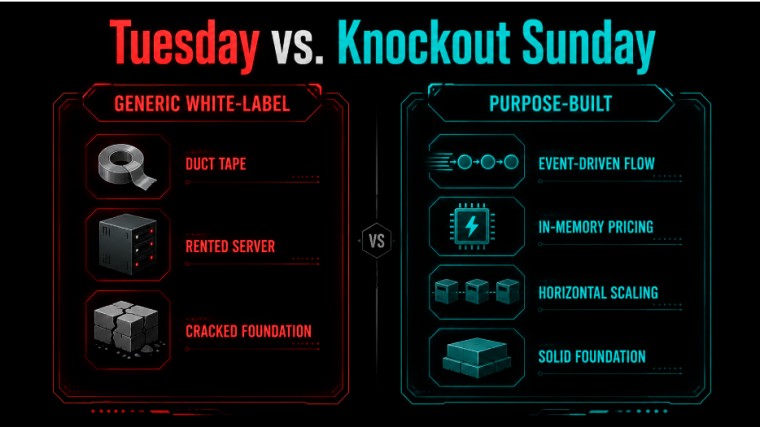
What Actually Holds Up
A platform built for this moment shares a few decisions that aren't up for negotiation:
- Event-driven architecture. A goal is an event that propagates and fires repricing, suspension, and settlement in parallel. Not a line of sequential queries begging a database not to fall over.
- In-memory, correlation-aware pricing, so the parlay is your money machine and not your leak.
- Idempotent, reversible settlement, to survive duplicate feeds and VAR reversals without paying twice.
- Horizontal scaling sized for the most violent beat, not the average.
- Graceful degradation. If something breaks, let it be one market — not the whole platform.
None of this is glamorous. It doesn't make the sales pitch or the welcome banner. It's plumbing. And plumbing is exactly what decides who cashes in and who apologizes on Monday.
The Tournament Ends. The Bill Doesn't.
I've been saying the same thing for years: in this industry, the winners dominate retention, not acquisition. The World Cup will bring you a wave of near-free users — the most expensive marketing on the planet, gifted to you by FIFA. The question was never how many come in. It's how many are still there in August, when there's no more World Cup and all that's left is your product, naked.
And that answer gets written now. In these 90 minutes. Every time someone scores and your platform has half a second to show what it's made of. The player doesn't care what an event-driven trading engine is. He only knows whether he got paid fast and right, or whether the app threw an error exactly when he was about to bet. That is your entire brand, compressed into half a second.
In this house, we don't bet on luck. We bet on engineering. The World Cup is the most honest referee you'll ever have: you can't lie to the load.
Categoría:Analysis
Tags: Wizards,
País: United States
Región: North America




Event




SBC Summit 2026
29 de September 2026
Uplatform Brought "Your Dreams. Our Platform" to Life at SBC Summit Lisbon 2026
Friday 09 Oct 2026 / 12:00
Kambi Highlights Network and LatAm Growth at SBC Summit
Friday 09 Oct 2026 / 12:00
GR8_TECH Highlights Speed and Growth at SBC Summit 2026
Friday 09 Oct 2026 / 12:00
SUSCRIBIRSE
Para suscribirse a nuestro newsletter, complete sus datos
Reciba todo el contenido más reciente en su correo electrónico varias veces al mes.